



Using AI for Support Plans and Forms
About this article
If you work in community or support services, you know the feeling: you finish a shift and then have to write it up. Support plans, funding applications, progress notes — sometimes it can feel like you spend more time writing about support than actually providing it.
This article shows practical ways AI tools like ChatGPT can help you get a solid first draft done in a fraction of the time, so you can spend more of your day focused on the people you support. AI isn't here to replace your judgement — it's here to take some of the strain off the paperwork.
This page covers the same core information as our AI for Support Plans and Forms video. Making information accessible matters to us, so we've shared this content in different formats.
This page covers the same core information as our Introduction to LLMs video (coming soon!). Making information accessible matters to us, so we’ve shared this content in different formats.
Reading time: Approx 8 minutes.
Before we start: one golden rule
Never enter real identifying information about the people you support into a public AI tool like ChatGPT, unless your organisation has approved a privacy-compliant version.
That means no full names, or first names combined with disability information, no addresses, and no sensitive health details from real support plans.
Throughout this article we'll use a fictional person called Sam. When you try any of this yourself, either use a pseudonym like we do, or remove identifying details first and add them back in once you're happy with the draft. For more on this, see Risk 3: AI has serious privacy risks in our [How to stay safe with AI] article.
Drafting a support plan
Let's start with a support plan. The key with AI is giving it enough context — the more useful information you provide, the better the result.
Here's the kind of prompt you could type into ChatGPT:
"Please write a person-centred support plan for Sam. Sam is 34 years old and has cerebral palsy. He communicates using a speech generating device and needs support with personal care, meal preparation, and getting to work three days a week. Sam's goals are to learn to cook two meals independently, to increase his confidence in the community, and to eventually move into his own flat. His support workers are Anna and Bob."
[SCREEN RECORDING: Ollie typing the prompt above into ChatGPT and the tool generating a full draft support plan with sections for background, goals, daily routines, and communication needs.]
Within a few seconds, ChatGPT produces a full draft with sections for background, goals, daily routines, communication needs and more. It won't be perfect, and you'll need to read it carefully — but it gives you a really strong starting point.
And this isn't just for support workers. People receiving support can use AI the same way to draft their own plans, think through goals, and prepare for planning meetings.
What else AI can help with
Support plans are just one example. AI can give you a useful first draft for lots of documentation, including:
support plans and goal-setting documents
Enabling Good Lives (EGL) plans
funding applications
progress notes and shift summaries
"About Me" profiles
handover documents for new staff
AI won't do any of this perfectly on its own — you still need to review everything carefully before it goes anywhere. But as a starting point, it can save a huge amount of time.
More structured forms (like EGL plans)
Some documents have specific questions that need to be answered in a particular way — an Enabling Good Lives plan is a good example.
For this kind of work, we recommend using a secure AI tool so you can safely upload real information. You can then give the AI a few things at once — for example: a referral, your meeting notes, and the blank EGL template — and ask it to fill in the plan for you.
A prompt might look like this:
"Using the information I've uploaded, please answer the questions in the EGL plan for Sam. Focus on Sam's vision for a good life, his strengths, and what support will help him achieve his goals."
[SCREEN RECORDING: Ingrid in a secure AI tool, uploading three documents (referral, meeting notes, blank EGL template) and then running the prompt above. Show the AI working through each question in the EGL format.]
UP TO HERE EVERYTHING NEEDS TO BE DELETED Video function
Some LLMs have video functionality on the paid plans. This works by giving the LLM tool access to your camera during a conversation, so the AI can see whatever is in your camera’s view. This can be really handy for people with vision impairments. In the video below, our vision-impaired colleague James is using ChatGPT video for the first time ever to read a menu at a cafe:
James was blown away by the video function of ChatGPT to assist him with reading a menu.
As with all camera-based tools, it’s important to think carefully about privacy and who or what is in view.
Image generation and review
Some LLM products include image generation. You can also access image-specific creation tools (such as MidJourney). Below are some images that we created using AI tools:

Photo realistic image generated by MidJourney
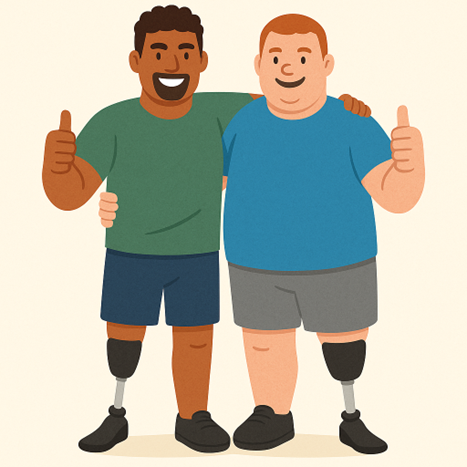
Cartoon image generated by ChatGPT
You can also upload your own images and talk to the LLM about them. This can be really handy if you want to produce Alt Text for a social media image, for instance (Alt Text is an image description for vision impaired people who use screen readers). You can also upload a photo of your fridge contents and ask for dinner inspiration ideas (my favourite use).
As with any images, it’s important to think about consent, dignity, and how disabled people are represented. Please check with people before you upload images of them into an AI tool.

One tool, many uses
Once you start using an LLM you will quickly see how useful it is. It’s great for helping with writing, including emails, reports, support plans, and funding applications. It’s also fantastic at proofreading. It can help you brainstorm ideas or provide constructive feedback on something you are working on. For instance, you can upload a strategic plan and ask it to review the plan and spot anything you might have missed out.
Use with care: LLMs are powerful, but not perfect
As useful as LLMs are, they do come with real risks — some of them serious.
If you haven’t already, we strongly recommend reading our article How to stay safe with AI or watching the accompanying video.
One of the most important things to remember is that AI tools can make mistakes. They can sound confident even when they are wrong.
As a rule of thumb:
If it involves your health or safety, check with a human expert.
If it involves money or legal issues, check with a human expert.
Don’t rely on AI alone
Avoid entering private or identifying information about yourself or other people (such as full names, addresses, health details, or anything from a support plan). If you need help with a document, remove identifying details first. We cover how to manage privacy risks in more detail in our article How to stay safe with AI and in the accompanying video.
Where to next?
This article is just an introduction. We’re developing a growing set of practical resources that go deeper into how LLMs can be used in everyday ways — especially in support and community contexts — and how to use AI safely, ethically, and effectively.
These will include:
How to use LLMs for writing support plans, reports, and funding applications
How to ask better questions (often called prompting) to get more useful results
Real-world examples of how disabled people and organisations are using AI
Clear guidance on safe, ethical, and accessible use
You don’t need to be “good with technology” to use these tools well. Curiosity, caution, and a willingness to double-check go a long way.
LLMs aren’t magic — but used thoughtfully, they can be powerful tools for saving time, reducing barriers, and increasing independence.

Continue learning
Explore these related guides to build your confidence using AI tools safely and effectively.

Stay Updated
More AI guides, videos, and practical resources are coming soon.

Supported by the Workforce Futures Fund |Tahua Rāngaimahi Anamata