

Is AI making us
more exhausted?
About this article
AI was supposed to save us time. But what happens when the time we save simply becomes more work?
The promise is:
You can do the same work in less time.
But the reality can become:
You can now do more work in the same time.
We started thinking seriously about this because we noticed it happening within our own team. AI was helping us get more done, but we were also becoming more tired. One of us described reaching the point of wondering whether their job had simply become too difficult.
The job had not changed. The rhythm of the work had.
Our discussions with our cultural advisory group, Pou Tikanga, have helped us think about what is happening through three interconnected ideas: manawa, wairua and whanaungatanga.
Contents:
Time to read: approx. 6 minutes.
Last updated: 4 November 2026.
Manawa: when work loses its rhythm
Signs things might have gone too far
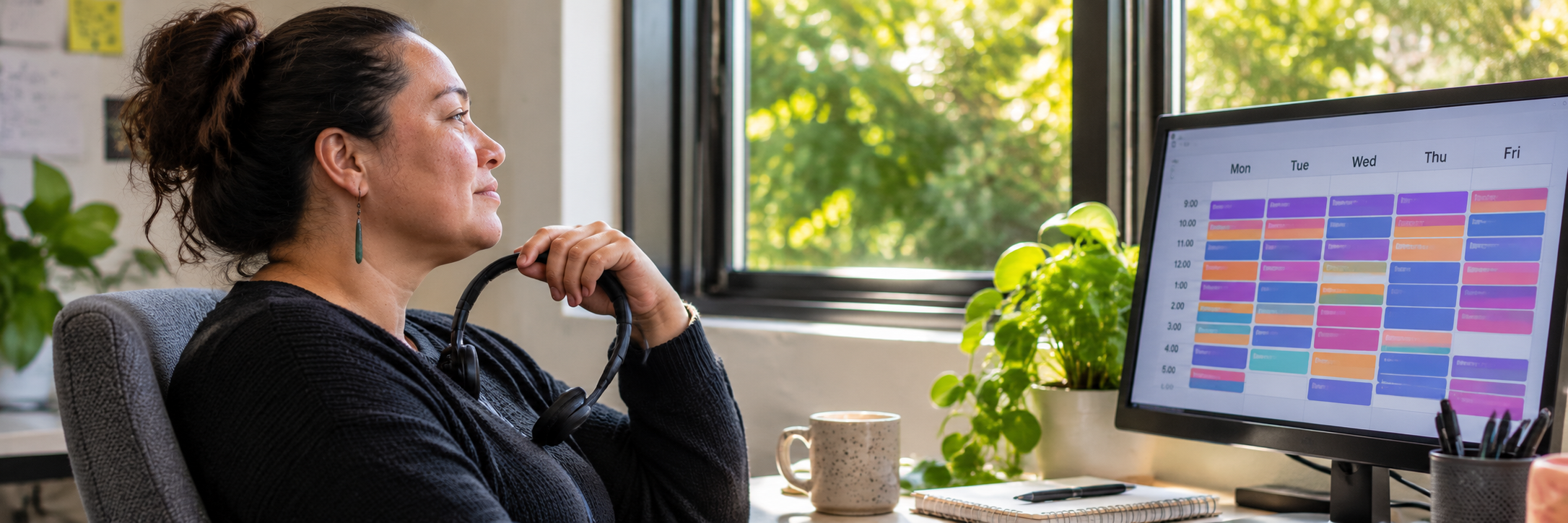
Manawa can mean breath, heartbeat and the life force that sustains us. It gives us a useful way to think about the natural rhythm between effort and rest.
Most jobs have a mixture of harder and easier tasks. You might have a difficult meeting, then spend some time tidying notes. You might work through a complicated support issue, then write a straightforward email. You might drive between visits and have ten minutes where your brain is not actively solving anything.
Those quieter tasks and gaps can give us time to process, recover and prepare for what comes next.
AI can remove some of them.
A useful example comes from call centres. AI can now deal with many routine enquiries, leaving human workers to handle the calls that are unusual, complicated or emotionally difficult. That sounds efficient, but it can also mean that staff spend much more of their day dealing with the hardest calls, one after another.
Something similar can happen in disability and community organisations. AI can draft the routine email, summarise the meeting, tidy the support note or organise the information. What remains for the worker is often the part requiring judgement: Is this accurate? Is this appropriate? What should we do? What does this mean for the person? What is the right decision?
The easier work has not simply disappeared. It has been replaced by more demanding work.
AI can also remove the pauses between tasks. Helena, one of our Pou Tikanga members, compared this with what happened when meetings moved online. Travel time disappeared, but instead of getting that time back, many of us simply scheduled more meetings. AI can create the same effect on a smaller scale: if a 30-minute task now takes five minutes, the remaining 25 minutes quickly become available for something else.
Over time, our manawa can become depleted. There is plenty of output, but less rhythm, less recovery and less room to breathe.
Wairua: when we lose ourselves in the work
What can help
Wairua refers to spirit — including what we bring to our work through our judgement, lived experience, relationships and sense of what matters.
AI can generate fluent language and useful ideas, but it does not bring our lived experience, relationships, judgement or knowledge of the people we work alongside. That distinction matters enormously in our sector.
A support note is not good simply because it is professionally written. A support plan is not good simply because every box is filled in. A report is not good simply because it sounds impressive. The person writing it brings knowledge of the individual, their whānau, their history, their preferences and what matters to them. AI cannot know those things unless someone brings them into the process — and even then, the human remains responsible for judging what is important.
We noticed this in our own work too. Writing used to be part of how we thought. AI made it possible to produce drafts much faster, but that also made it easier to outsource some of the thinking that happened through writing.
There is emerging research about cognitive debt [Reference 1 - see the bottom of the page]. That is, the possibility that repeatedly handing thinking tasks to AI may affect how deeply we engage with, remember and feel ownership over our own work. The research is still developing, so we should not overstate what we know. But the practical question is already worth asking:
Can I still recognise my own thinking in this work?
If the answer is increasingly no, efficiency may be costing us something important.
Protecting wairua does not mean avoiding AI. Sometimes the right choice is not to use it at all. When we do use AI, it should support our thinking rather than quietly replace it.
Whanaungatanga: what happens to the human connection?
Sometimes the problem is not just you
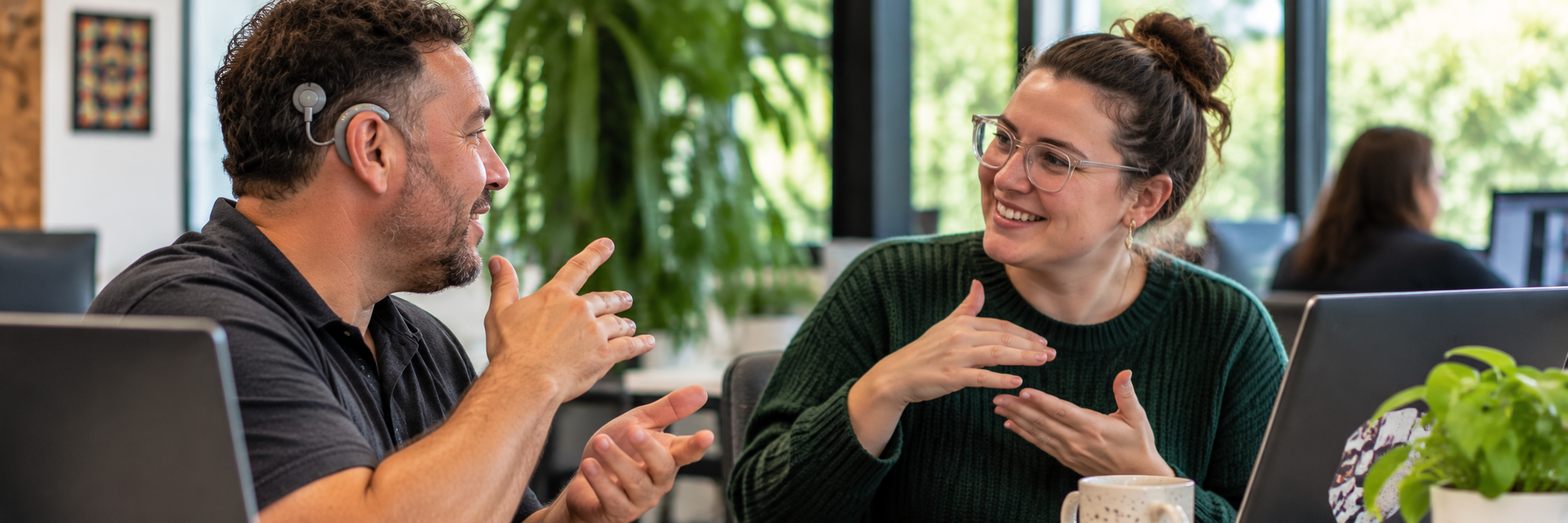
Whanaungatanga is about relationships, connection, belonging and the responsibilities we have to one another.
In disability and community work, relationships are not an optional extra. They are part of the mahi.
AI could genuinely give us more time for those relationships. If it reduces paperwork, perhaps a support worker has more time with the person they support. If it takes care of routine administration, perhaps a manager has more time to talk with their team.
But that does not happen automatically. The time saved can just as easily become another report, another meeting or another task.
There is also a risk that we start replacing small human interactions because AI is quicker. We ask the chatbot instead of the colleague beside us. We generate an answer instead of talking something through.
Collective thinking brings together different perspectives, skills and lived experiences. Human conversation also involves more than words: tone, energy and body language all shape our understanding. Talking together builds relationships and gives people opportunities to contribute.
AI can support brainstorming, but its responses are shaped by our prompts and the data it was trained on. It cannot recreate what happens when people with different experiences think together. Through the lens of whanaungatanga, these conversations are not inefficient — they are a valuable part of the work.
AI should support collective thinking, not quietly replace it.
Protecting manawa, wairua and whanaungatanga
More efficient — but towards what?

None of this means AI is inherently bad for wellbeing. Used intentionally, it can reduce repetitive work, support accessibility and create more capacity for the things that matter.
But efficiency should not be our only measure of success. Instead of asking only whether AI helps us work faster, we can ask whether it helps us create more value.
In disability and community work, value might mean better support, stronger relationships, more thoughtful decisions, improved accessibility, or work that people can sustain without becoming depleted.
If we use the capacity AI creates to increase workloads, concentrate the hardest tasks, reduce opportunities to think and squeeze out human connection, we need to ask whether that is really progress.
The challenge is not simply to ask, How much more can AI help us do?
It is to ask, What kind of working life are we trying to create, and is the way we are using AI taking us towards it?
In the final article in this series, we look at what organisations can do to create an intentional AI culture that protects manawa, wairua and whanaungatanga — rather than simply increasing how much work people can produce.
References
Reference 1: Kosmyna, N., Hauptmann, E., Yuan, Y. T., Situ, J., Liao, X.-H., Beresnitzky, A. V., Braunstein, I., & Maes, P. (2025). Your Brain on ChatGPT: Accumulation of cognitive debt when using an AI assistant for essay writing task. arXiv. https://doi.org/10.48550/arXiv.2506.08872

Ma te huruhuru ka rere ai te manu. With feathers, a bird can fly.
Information is your feathers. We hope this article gives you a few more of them.
👉 Want to understand how AI actually works? Read our Introduction to AI article, watch the video, or watch the NZSL video.
👉 Ready to think about using it safely? Read our AI Safety article, watch the video, or watch the NZSL video.
👉 Want to stay updated on our work? Register here.
This article was written by our team, with support from AI. The ideas, analysis, and final decisions are our own. We reviewed the information and references carefully before publishing, because AI can make mistakes.
Supported by the Workforce Futures Fund |Tahua Rāngaimahi Anamata