

Building an intentional
AI culture
Is AI making us
more exhausted?
About this article
AI can help us get more done in less time. But what happens to the time we save? Does it create more space for people, relationships and wellbeing, or does it simply become an opportunity to do more work?
In our previous article, we explored how AI can make individual tasks easier while making work as a whole more intense.
In this article, we look at what organisations can do about it. Drawing on our discussions with Pou Tikanga, our cultural advisory group, we explore how manawa, wairua and whanaungatanga can help us think differently about productivity and workplace wellbeing.
We also look at practical ways organisations can build an intentional AI culture — one where technology serves people and kaupapa, rather than the other way around.
Time to read: approx. 7 minutes.
Last updated: 6 November 2026.
Contents:
When saving time creates more work
Signs things might have gone too far
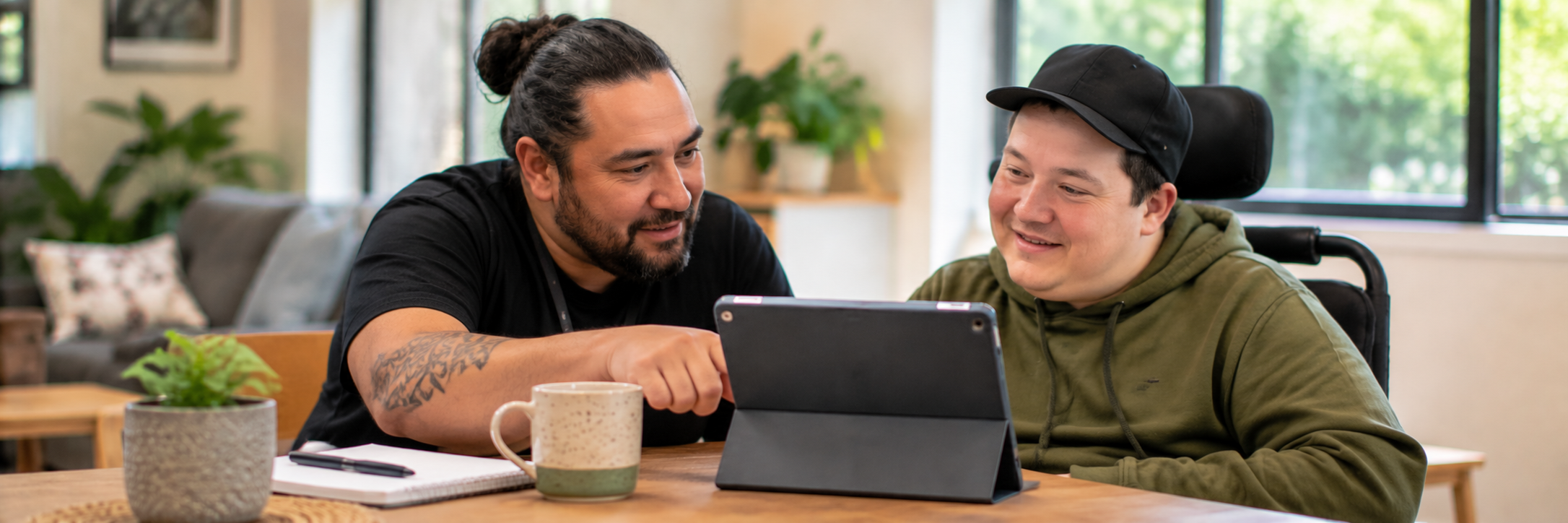
Imagine Hemi, a support worker in a supported living service. At the end of each shift, he used to spend about 15 minutes writing his shift summary. One of the people he works closely with is Jamie.
Those 15 minutes were partly paperwork, but they were also a form of reflective practice. As Hemi wrote, he thought about what had happened, what mattered and how he had responded.
One day, Jamie completed something independently after Hemi stopped trying to help and gave him more time. Writing the summary helped Hemi recognise that he had stepped in too quickly. That was useful learning for Hemi.
Then Hemi chose to start using an approved AI tool. He could jot down the main points from the shift and turn them into a polished summary in three or four minutes. It was genuinely useful, and Hemi felt it worked well for him.
Gradually, the time AI saved was filled with more administrative work. Hemi began helping with reviews, support plans and scheduling. AI was doing more of the drafting and organising, while Hemi was doing more checking, deciding, planning and judging.
Because everyone knew a shift summary could now be completed in a few minutes, spending 15 minutes on it started to feel wasteful. Nobody needed to tell Hemi to hurry up. He knew he could be doing something else.
Before long, Hemi was getting much more done, but he was also exhausted.
What happens to the time AI saves?
What can help
In the previous article in this series, we looked at how AI can make individual tasks easier while making work as a whole more intense.
Hemi’s experience shows why this is not simply a question of whether AI works. It does work. His documentation is faster, and tasks that once consumed significant administrative time can be done much more efficiently.
But if a task takes 10 minutes instead of 30, those 20 minutes do not automatically become more time with the person being supported, more time to think, or a less pressured working day. They can just as easily become another task.
AI does not decide what happens to the time it saves. Workplace culture does — sometimes without anyone realising a decision is being made.
Disability communities have spent decades challenging the assumption that when somebody is struggling, the first question should be, “What is wrong with this person?” The social model asks us to look at the environment around them. We can apply the same thinking to workplace wellbeing.
If Hemi is exhausted, better time management or stronger personal boundaries might help him. But we should also ask what has changed around him. Has his workload grown because AI makes more possible? Has his role expanded? Has the balance between easier and harder work changed? Have the pauses that used to give him time to think quietly disappeared?
What looked like 15 minutes of administration had also been 15 minutes of thinking and reflection. Making the writing faster did not make that reflection unnecessary.
People are taonga. AI is the resource.
Sometimes the problem is not just you
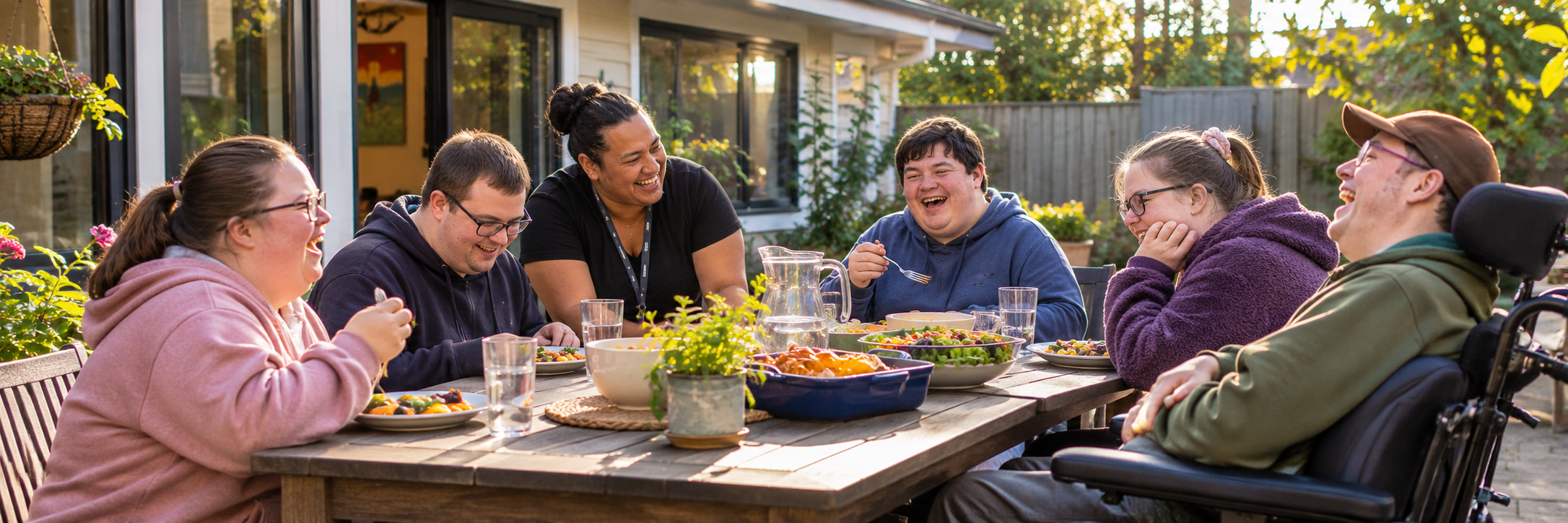
We have been exploring the ideas in this article with Pou Tikanga, our cultural advisory group, which helps ground our AI for People work in te ao Māori and Pacific perspectives.
One of the ideas that has emerged from those discussions is the importance of treating people as taonga.
If we see workers mainly as productive resources, an efficiency gain creates an obvious opportunity: the same person can now produce more. But people bring relationships, knowledge, judgement, creativity, energy and lived experience to their work. Those things need sustaining, not simply extracting more from.
Our Pou Tikanga discussions have also drawn on kaitiakitanga — guardianship. If people are taonga and AI is a tool in the kete (basket), then our responsibility is to make deliberate choices about how the tool is used and what we want its benefits to create.
That might mean more output. There will be times when completing something faster genuinely improves a service. But increased capacity could also mean more time with people, less overtime, better reflection, stronger relationships or simply a more sustainable working day.
The important thing is that we decide.
Protecting manawa, wairua and whanaungatanga
What are we trying to protect?
Our discussions with Pou Tikanga have given us three useful ways of thinking about what an intentional AI culture might protect: manawa, wairua and whanaungatanga.
Protecting manawa: Paying attention to the rhythm of work. Manawa can refer to breath, heartbeat and the life force that sustains us. If AI removes routine tasks and every minute saved is filled again, people can end up moving continuously between complex decisions and demanding interactions.
An intentional culture does not automatically treat saved time as spare capacity. It notices workload creep and protects the pauses people need to think, transition and recover.
Honouring wairua: Protecting what people themselves bring to the work: their judgement, values, creativity, lived experience and knowledge of the people involved.
Hemi might use AI to produce an excellent first draft of Jamie’s support plan, but Jamie can still read it and say, “That doesn’t really sound like me.” A document can be polished and still lose something important. Staff need to be able to question AI, change what it produces and, where possible, have a say in which parts of their work are better done without it.
Strengthening whanaungatanga: Making sure efficiency creates space for relationships rather than squeezing them out.
Jamie may still receive exactly the same number of support hours from Hemi, but those hours feel different if Hemi is increasingly checking documents, arranging schedules or finishing administrative tasks while they are together. If AI saves time, organisations can deliberately ask whether some of that time should go back into kōrero, team connection and being present with the people they support.
The question is not whether faster is good or bad. Sometimes speed creates independence, accessibility and choice. The question is whether speed has quietly become the measure of success.
What kind of organisation are we trying to build?
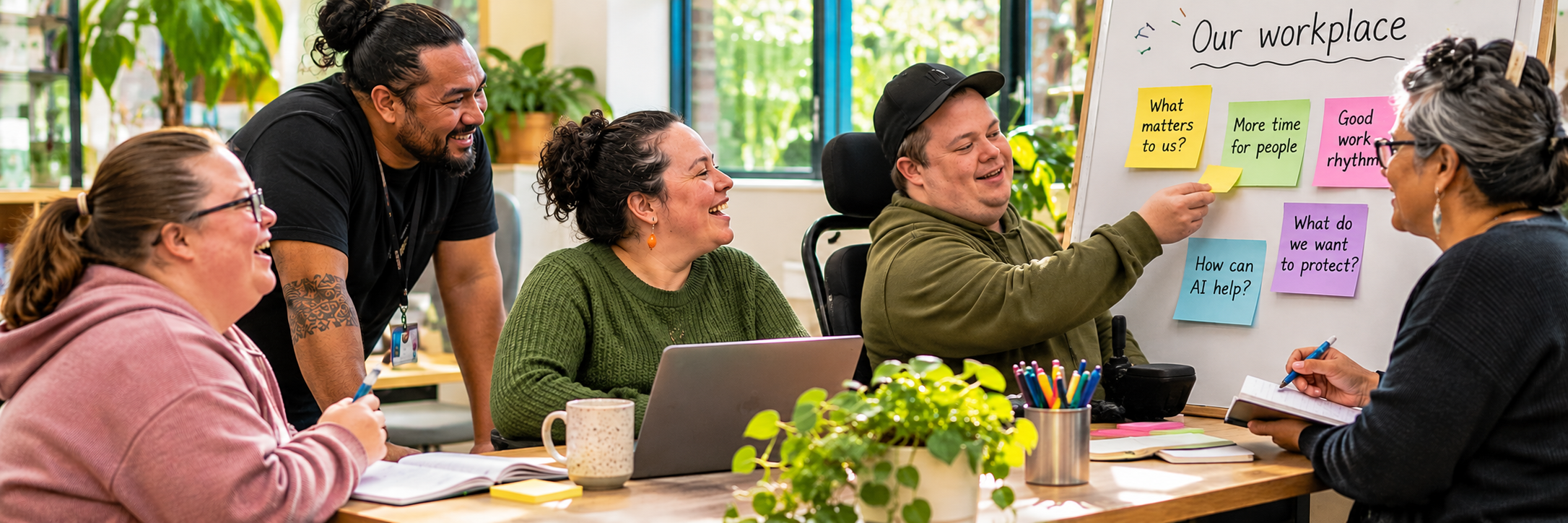
An intentional AI culture starts with a bigger question than, “How much more work can we get done?”
It asks:
What kind of organisation are we trying to build, and is the way we are using AI moving us towards it?
If we want workplaces where people have time to think, where relationships matter, where staff can exercise judgement and where disabled people experience greater choice and control, then those things need to shape how we use the capacity AI creates.
Efficiency is not the destination. It gives us choices.
A faster support note might create five extra minutes. A faster report might create an hour. A better scheduling system might save a manager several hours each week. Across an organisation, those small gains can add up to significant capacity.
The question is what we choose to build with it.
Four ways to build an intentional AI culture
There is no single formula for creating a healthy AI culture. Different workplaces will use AI differently, and its effects will change as the technology develops. But there are some things organisations can do deliberately.
Use efficiency to create a more sustainable workload.
When AI saves time, decide what you want that time to create. Sometimes the right choice will be more output. At other times it might be breathing room, less overtime, better preparation or more capacity to respond well when something unexpected happens. The important thing is not to assume that every efficiency gain automatically becomes room for more work.Protect thinking and support choice.
AI can take over some drafting, formatting and organising, but people still need opportunities to reflect, exercise judgement and learn from their own practice. Give workers practical guidance, while recognising that the same tool may help one person and hinder another. Where possible, involve staff in deciding when and how they use AI, and check regularly whether it is helping or creating additional strain.Use saved time to strengthen relationships.
Where possible, direct some of the capacity AI creates back towards people: more time for kōrero, stronger team connection, better support, and being more present with the people you work alongside. Ask the people receiving support what they notice and whether the way technology is being used is improving their experience.Keep the kaupapa in view.
Return regularly to the bigger question: What kind of organisation are we trying to build, and is our use of AI helping us get there? If your goal is greater choice and control, stronger relationships, sustainable work and better outcomes for disabled people, those should be visible in the way you use the capacity AI creates.
These are not decisions to make once when an AI policy is written.
Workplace culture develops through hundreds of small choices: what gets measured, what work gets added, what people are praised for, what starts to feel “too slow”, and what happens to the time technology saves.
Hemi does not need to stop using AI. His shift summaries really are easier to produce. The opportunity is to recognise that making the writing faster does not mean the thinking, reflection and relationship around the work have suddenly become unnecessary.
AI can create capacity. What that capacity becomes is up to us.
An intentional AI culture makes these choices deliberately. It uses technology to help create the kind of workplace and the kind of community it actually wants — one where AI serves people and kaupapa, rather than gradually reshaping people around what the technology makes possible.

Ma te huruhuru ka rere ai te manu. With feathers, a bird can fly.
Information is your feathers. We hope this article gives you a few more of them.
👉 Want to understand how AI actually works? Read our Introduction to AI article, watch the video, or watch the NZSL video.
👉 Ready to think about using it safely? Read our AI Safety article, watch the video, or watch the NZSL video.
👉 Want to stay updated on our work? Register here.
This article was written by our team, with support from AI. The ideas, analysis, and final decisions are our own. We reviewed the information and references carefully before publishing, because AI can make mistakes.
Supported by the Workforce Futures Fund |Tahua Rāngaimahi Anamata